The grid that looked like everything
It started with something almost trivial: a grid of cells, each holding a number we called "energy," and one rule — every step, each cell shares its value with its neighbors. Run it and it does hypnotic things. Signed values flow together and cancel like matter and antimatter. Trapped in a well, standing waves take on the two-lobed shape of atomic orbitals. Add a pull and the field condenses into clumps and voids that look, if you squint, like the large-scale structure of the universe.
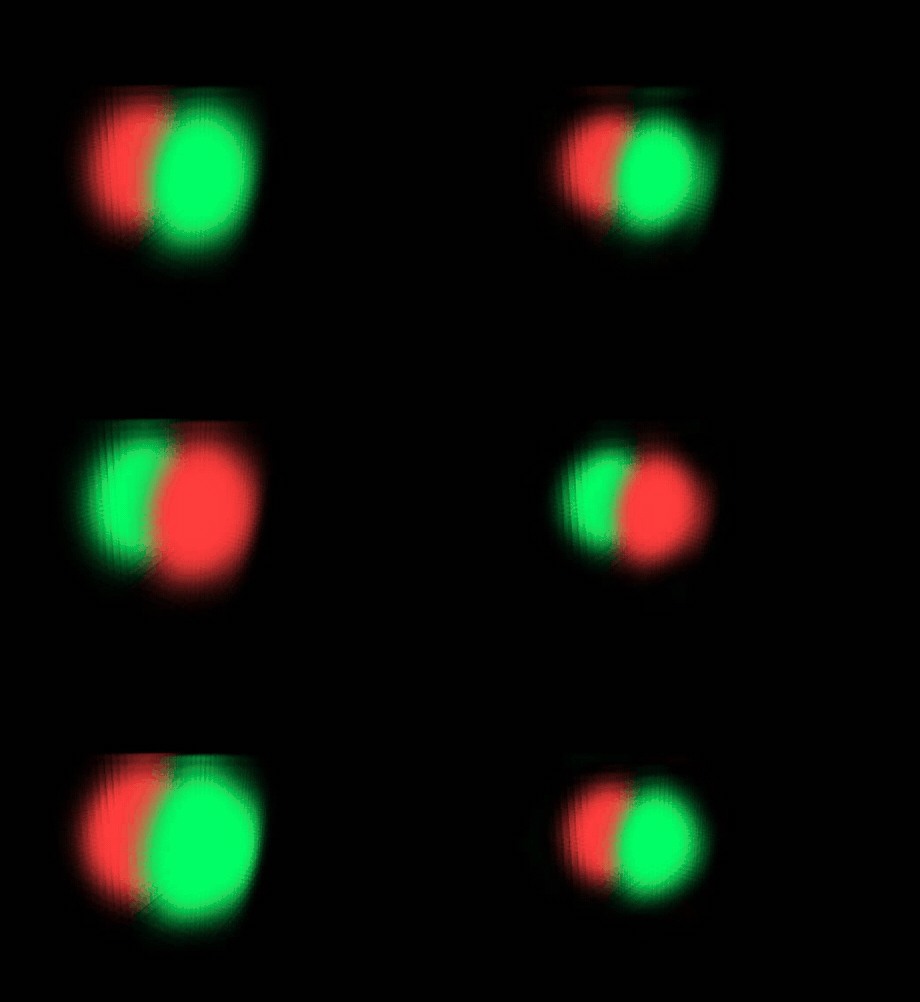
It is very easy, watching that, to feel like you've found something enormous. We did. The pull to believe a simple rule secretly explains forces, atoms, maybe the cosmos is real — and it isn't even unreasonable, because the resemblances are genuine. But this is the story of how our understanding evolved past that feeling, through two disciplines that turned out to matter more than any intuition. The first was measure, don't argue. The second, harder one, was verify the picture, don't trust the metric — and it caught us, at the very end, in the exact trap we thought we'd learned to avoid.
Measure, don't argue
The first grand claim was momentum. The patterns move — a pulse spreads outward, and something looks like it's propagating on its own. Was that momentum, a real force? Or just spreading?
Instead of debating it, we measured the one thing that tells them apart. A front driven by pure diffusion grows like √t — it decelerates. A front carrying momentum grows like t — constant speed. So we dropped a spike in the middle of a big grid, tracked how far it spread over hundreds of steps, and fit the exponent.
It came back 0.5000. Exactly √t. Not momentum, not emergent force — diffusion, to four decimal places. The animation had a vote; the number overruled it. That is the whole discipline in one moment: when something you built looks profound, the exponent doesn't care what your eyes believe, and the honest move is to update, not to defend.
Knowledge grows by ingredients, not by proclamation
From there, understanding didn't arrive as one grand revelation. It accumulated as ingredients, each one added and then measured:
- Give every cell a velocity, and the diffusion becomes a wave — it rings instead of fading. One extra term (a second time-derivative) is the entire difference between heat and waves.
- Make cells flow toward density instead of away, and energy clumps instead of spreading.
- Make that pull long-range, and the clumps feel one another and merge — all the way down to a single point.
- Let the pull fade over time, the way expansion dilutes gravity, and total collapse is averted.
- Add pressure pushing back, and a clump settles at a finite size instead of a point.
Every one of these was a separate, testable piece, and each was checked with a number: a conserved sum, a peak value, an effective size. This is the quiet truth about how knowledge actually evolves — not one rule that secretly does everything, but a stack of small mechanisms whose individual effects you can prove. The system became less mysterious and more powerful at the same time, precisely because we stopped asking "what could this be?" and started asking "what does this term do?"
When the number itself lies
And then we walked straight into the deeper version of the trap.
We ran the long-range-plus-fading rule and read off a metric that had been reliable all along — a measure of how spread out the mass was. It settled at about 137. We called it "a stable web of 137 clumps," wrote it into the documentation, and moved on. It fit the story beautifully: gravity builds structure, expansion freezes it into a cosmic web. It felt like the payoff.
It was wrong. When we finally rendered the actual field and counted the distinct clumps — the literal local maxima — there was one. A single broad blob. That "137" was a participation ratio; it measures effective occupied cells, not separate structures, and one fat blob smeared across 137 cells produces exactly that number. The web we'd described didn't exist — long-range gravity had funnelled everything into a single central lump. The real many-clump structure was hiding in a different rule (local, short-range attraction, which genuinely leaves 296 separate clumps and voids) — nearly the opposite of what we'd claimed.
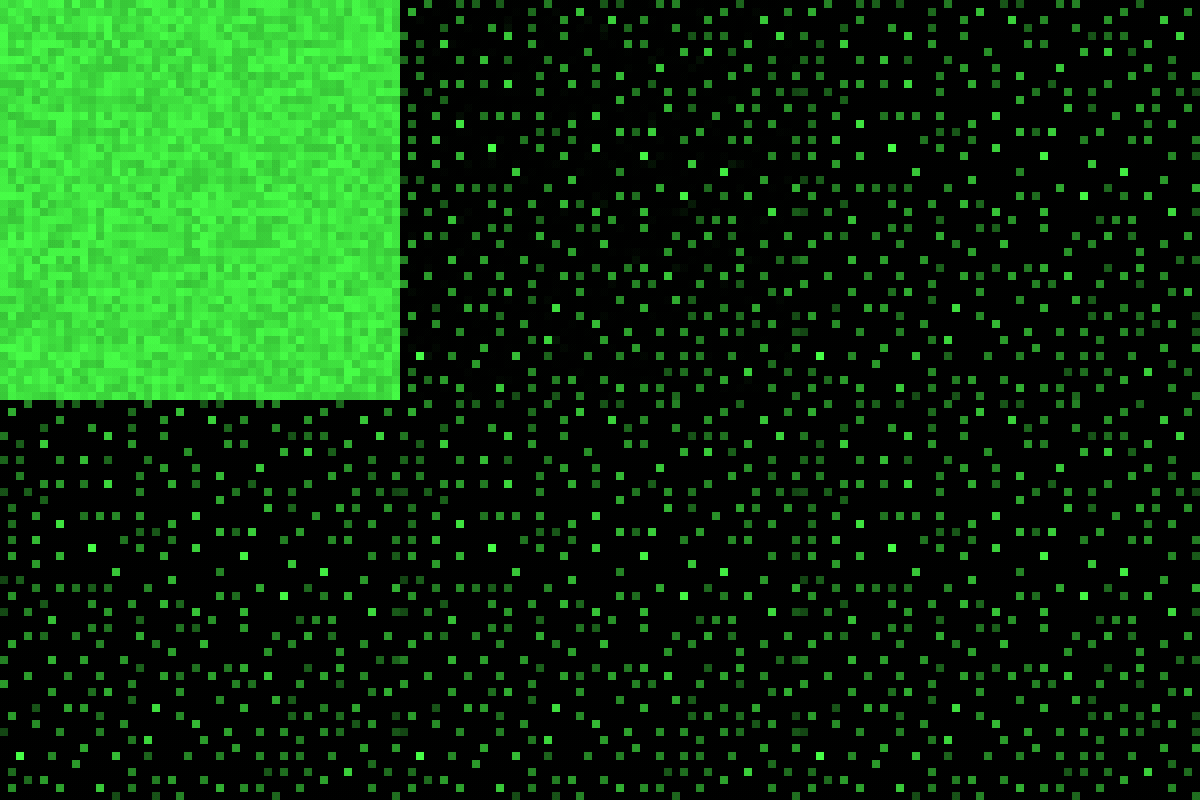
Here is the part worth sitting with. This entire project had been a lecture on not trusting a number that merely resembles the answer. And we — a person and an AI, both being careful — trusted a number that merely resembled the answer. The metric looked like a clump count. It wasn't. Nothing caught it except doing the most boring possible thing: drawing the picture and counting the dots.
Resembles is not is — for phenomena and for numbers
That is the spine of everything we learned. "Resembles ≠ is" is usually aimed at phenomena: a diffusion pattern looks like an orbital but isn't one; a field of dots looks like the cosmic web but isn't (the real thing needs genuine gravity, realistic initial conditions, and expansion in comoving coordinates — actual N-body cosmology, not a scalar toy on a small grid). But the sharper, less comfortable lesson is that resemblance deceives one level up, too. A metric can resemble the quantity you care about and quietly not be it. A participation ratio resembles a clump count. A √t front resembles motion. An animation resembles dynamics.
The cure is identical at every level, and it is unglamorous: build the actual thing and count it. Render the field. Fit the exponent. Enumerate the maxima. Every place we did that, we learned something true. The one place we skipped it — trusting a friendly number because it fit the narrative — is the one place we were wrong, in writing, until we went back and looked.
The grand and the true
None of this means the reaching was foolish. The system genuinely rhymes with deep physics, for real reasons. The same Laplacian operator sits at the heart of the heat equation, the wave equation, and Schrödinger's; the ingredients of cosmic structure really are clumping, merging, expansion, and pressure. Those resemblances are not illusions — they are why the intuition felt like it might be everything. The discipline is not to kill that feeling. It is to earn it: to keep exactly as much of the grandeur as the measurements will bear, and not one decimal more.
That, in the end, is how our knowledge actually evolved — not from certainty to certainty, but from a big, thrilling guess to a small pile of things we could prove. The guess was left intact wherever it turned out to be true, and cut back, precisely and out loud, wherever it wasn't. The universe inside the grid got smaller. What we could honestly say about it got much, much bigger.